Every employer in Cyprus carries a legal duty to protect the safety, health and welfare of its workforce. That duty is set out principally in the Safety and Health at Work Law of 1996 (Law 89(I)/1996) and its many amendments and subsidiary regulations, a framework shaped by the EU and enforced by the Department of Labour Inspection of the Ministry of Labour and Social Insurance. This guide explains what the law requires and how employers can manage their obligations.
The General Duty
The cornerstone of the legislation is a broad, positive duty: every employer must ensure, so far as is reasonably practicable, the safety, health and welfare at work of all its employees. The law also imposes duties towards third parties who may be affected by the employer’s activities, and places obligations on self-employed persons and on designers, manufacturers, importers and suppliers of equipment and substances used at work. Employees, in turn, must take reasonable care for their own safety and that of others, cooperate with the employer, and not misuse or interfere with safety measures.
Risk Assessment and the Management System
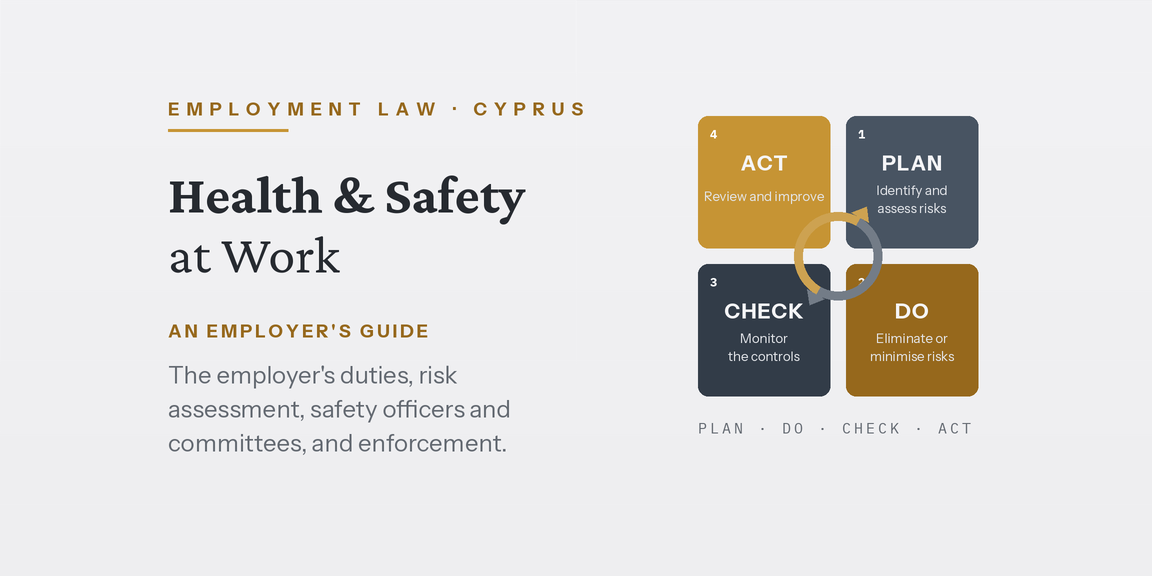
At the heart of compliance is the written risk assessment. Employers must identify the hazards present in the workplace, assess the risks to employees and others, and put in place preventive and protective measures, following the recognised hierarchy of avoiding risks at source before relying on protective equipment. The assessment must be documented, kept up to date, and translated into a working management system — supported by the Management of Safety and Health at Work Regulations. Employers must also provide employees with information, instruction, training and supervision, arrange health surveillance where appropriate, and prepare for emergencies such as fire and first aid.
Safety Officers, Services and Committees
The law requires employers, depending on the nature and size of their undertaking, to organise prevention and protection arrangements:
Internal prevention and protection service. Employers must arrange competent resources for managing safety and health. In smaller undertakings the employer may, if suitably qualified, undertake this role personally; larger operations require designated competent persons.
Safety officer. An employer that engages, on average, more than 200 persons must appoint a dedicated, full-time safety officer, approved by the Chief Inspector (Law 89(I)/1996, section 10). The safety officer supports the employer in maintaining the written risk assessment and risk-management system, conducts workplace inspections to identify hazards, helps organise training, takes part in the safety committee and accompanies labour inspectors during visits.
Safety representatives and committee. A safety representative is elected wherever an employer engages more than two persons (Law 89(I)/1996, section 7); in larger workplaces a safety committee is also established, providing a formal channel for consultation between the employer and the workforce on health and safety matters.
Specific Risks and Sector Rules
Beyond the framework law, a substantial body of subsidiary regulations addresses particular hazards and settings — among them workplaces and work equipment, manual handling, personal protective equipment, display-screen work, noise and vibration, chemical, carcinogenic and biological agents (an area attracting renewed international attention through recent ILO standard-setting), and the construction sector, which carries its own detailed regime. Employers should identify which specific regulations apply to their activities and address them within their risk assessment.
Enforcement and Consequences
The Department of Labour Inspection inspects workplaces, investigates accidents and occupational diseases, and enforces the legislation. Inspectors have wide powers, including to issue improvement and prohibition notices and to bring prosecutions. Breach of health and safety duties is a criminal matter and can expose an employer to fines and, in serious cases, imprisonment, alongside civil liability for harm suffered by employees and the significant operational and reputational consequences of a serious incident. Certain accidents and dangerous occurrences must also be reported to the authorities.
Practical Guidance for Employers
Get the risk assessment right. It is both the legal foundation and the practical heart of compliance. Ensure it is genuine, specific to your workplace, documented and reviewed — not a generic template.
Put the right people and structures in place. Confirm whether your undertaking requires a safety officer, a prevention and protection service, safety representatives or a safety committee, and ensure those appointed are competent and active.
Train and consult. Provide proper information and training, and consult employees and their representatives — both a legal requirement and the most effective way to prevent incidents.
Keep records and prepare for inspection. Maintain documentation of assessments, training, maintenance, incidents and reporting, so you can demonstrate compliance if the Department of Labour Inspection visits.
How We Can Help
We advice employers across Cyprus on health and safety compliance, the structure of prevention and protection arrangements, accident investigation and reporting, dealings with the Department of Labour Inspection, and the defence of enforcement action and related claims. If you would like to review your health and safety obligations, we would be pleased to assist.
This article is provided for general information purposes only and does not constitute legal advice. It reflects the position as at the time of writing; readers should seek specific advice on their circumstances.
Theodorou Law is a Cyprus law firm with Cyprus lawyers and other legal experts on legal matters involving Cyprus law, EU law and international law. The above should be used as a source of general information only. It is not intended to give a definitive statement of the law.
If you have a query or wish to receive further information, please contact us using [email protected]