Few areas of employment law carry as much financial and reputational risk as getting a dismissal wrong. In Cyprus, the rules are set principally by the Termination of Employment Law of 1967 (Law 24/1967), supplemented by later legislation and case law, and they apply across the private, public and semi-governmental sectors. This guide explains the essentials, the lawful grounds for dismissal, the notice an employer must give, when a dismissal becomes “unfair,” and how redundancy and the Redundancy Fund work.
Lawful Grounds for Dismissal
An employer cannot dismiss at will. Termination must rest on a reason the law recognises, and the burden falls on the employer to justify it. Recognised grounds include the employee’s failure to perform their duties satisfactorily, redundancy, the expiry of a genuine fixed-term contract, force majeure (act of God, war and similar events), and the employee reaching pensionable age. A dismissal that does not fall within an accepted ground, or that fails to follow proper procedure, may be challenged as unfair.
Notice Periods
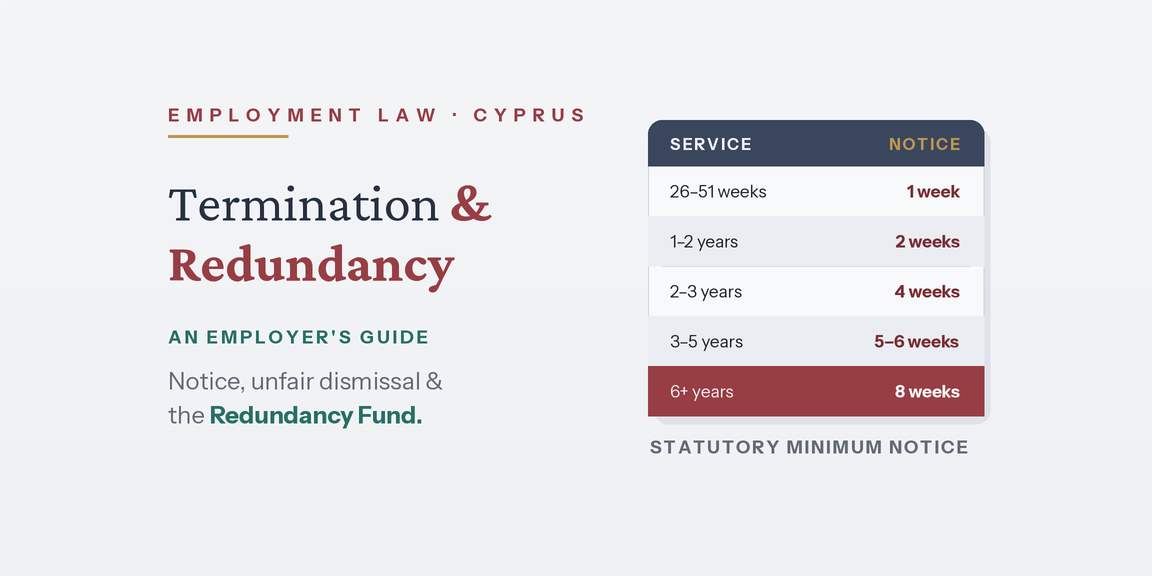
An employer intending to dismiss an employee who has completed at least 26 weeks of continuous service must give written notice. The minimum statutory period increases with length of service:
| Length of continuous service | Minimum notice |
|---|---|
| 26–51 weeks | 1 week |
| 52–103 weeks | 2 weeks |
| 104–155 weeks | 4 weeks |
| 156–207 weeks | 5 weeks |
| 208–259 weeks | 6 weeks |
| 260–311 weeks | 7 weeks |
| 312 weeks or more | 8 weeks |
These are minimums: a contract, collective agreement or established custom may require longer, and that longer period prevails. An employer may give payment in lieu of notice instead of requiring the employee to work it. Notice must be in writing and state clearly when it begins and ends. Special protection applies during maternity leave, when notice generally cannot be given.
Dismissal Without Notice
In cases of serious (gross) misconduct, the law permits immediate dismissal without notice or payment in lieu, for example, a serious or repeated breach of work rules, the commission of a criminal offence in the course of duties, or comparable conduct that makes continued employment untenable. The risk for employers is that the burden of proving such misconduct lies squarely with them, and a fair process (including, in practice, giving the employee an opportunity to respond) remains important. Summary dismissal that cannot be justified will expose the employer to an unfair-dismissal claim.
Unfair Dismissal and Compensation
An employee with at least 26 weeks of continuous service who is dismissed without lawful justification may bring an unfair-dismissal claim before the Industrial Disputes Court (also known as the Labour Disputes Court). The claim must generally be filed within 12 months of the termination.
Compensation is assessed by the Court and, by statute, can be no less than the redundancy payment the employee would have received had they been made redundant, and no more than two years’ wages. In fixing the amount, the Court weighs factors including the employee’s earnings, length of service, age, loss of career prospects and the circumstances of the dismissal. Compensation up to one year’s wages is payable by the employer, with any excess met from the Redundancy Fund.
Certain dismissals are treated as automatically unfair, notably those connected to trade-union membership or activity, or made in response to an employee’s complaint against the employer. Where a dismissal by an employer of 20 or more employees (more than 19) is found unlawful and in bad faith, the Court also has power, on the employee’s application, to order reinstatement, together with compensation for actual loss, up to a maximum of twelve months’ wages. Where a remedy such as loss of career prospects or injury to reputation cannot be fully satisfied by the Industrial Disputes Court, the employee may instead pursue a claim in the Civil District Court.
Redundancy and the Redundancy Fund
Redundancy is a lawful ground for dismissal, but it carries its own entitlements and procedures. An employee who has been continuously employed for at least 104 weeks (two years) by the same employer and is dismissed by reason of redundancy is entitled to a redundancy payment from the state-administered Redundancy Fund. The amount is calculated on a statutory sliding scale (set out in the Fourth Schedule to the Law) by reference to the employee’s length of service and last wages:
| Period of continuous employment | Redundancy payment |
|---|---|
| Up to 4 years | 2 weeks’ wages for each year of service |
| Over 4 and up to 10 years | 2½ weeks’ wages for each year of service |
| Over 10 and up to 15 years | 3 weeks’ wages for each year of service |
| Over 15 and up to 20 years | 3½ weeks’ wages for each year of service |
| Over 20 and up to 25 years | 4 weeks’ wages for each year of service |
Two points temper the headline figures: for the purpose of the calculation, wages above four times the basic insurable earnings (as set under the social insurance legislation) are disregarded, and the payment is reduced for employees working beyond age 64. The Fund itself is financed entirely by employer contributions (currently 1.2% of insurable earnings, paid together with social insurance contributions); the employer does not pay the statutory redundancy sum directly to the employee, but funds the system through those contributions.
Redundancy arises where the need for the employee’s work has ceased or diminished, for example on a business closure, restructuring, or technological or economic change. Employers must follow the correct process, which includes notifying the Minister of Labour at least one month before the redundancy takes effect (form SIS 608). The employee’s own claim for payment from the Fund (form SIS 600) must be submitted within three months of dismissal, extendable to twelve months for good cause. For a period after the redundancy, an employer that resumes hiring must give priority in re-employment to staff dismissed on redundancy grounds. Importantly, redundancy must be genuine: using “redundancy” as a cover for what is really a performance or personal dismissal is a frequent source of successful claims.
Collective Redundancies
Where redundancies reach a larger scale, additional obligations under the collective-redundancies framework apply — including advance information and consultation with employee representatives and notification to the authorities — before any dismissals take effect. Employers contemplating multiple redundancies should take advice early, as the consultation steps must be completed properly and in good time.
Probation
During a probationary period, the position is different: either party may terminate without notice, and the protections against unfair dismissal and the redundancy-payment entitlement do not apply. Since 2023, however, probation is capped at six months under the Transparent and Predictable Working Conditions Law (with limited exceptions, such as board members). The practical effect is that the window in which an employer can part ways with a new hire without engaging termination protections is now much shorter than it once was, making careful recruitment and timely probation reviews more important than ever.
Practical Guidance for Employers
Identify and document the ground. Be clear, before acting, which lawful ground applies, and keep the evidence that supports it — performance records, warnings, or the business case for redundancy.
Follow a fair process. Procedural error is one of the most common reasons employers lose dismissal claims. Give proper written notice (or pay in lieu), and, where conduct or performance is in issue, allow the employee a genuine opportunity to respond.
Treat redundancy as a process, not a label. Confirm the redundancy is genuine, notify the Minister of Labour in time, observe selection fairness, and honour re-employment priority.
Mind the clock and the thresholds. The 26-week and 104-week service thresholds, the six-month probation cap and the 12-month claim window all shape exposure. Diarise them.
Take advice before, not after. The cost of getting a dismissal right is small compared with the cost of defending an unfair-dismissal or redundancy claim — or paying up to two years’ wages in compensation.
How We Can Help
We advice employers and employees across Cyprus on dismissals, redundancy planning and process, settlement, and the conduct of claims before the Industrial Disputes Court. We can assess the risk of a proposed dismissal, design a compliant redundancy process, calculate entitlements, and represent you if a dispute arises. If you are contemplating a termination or facing a claim, we would be pleased to assist.
This article is provided for general information purposes only and does not constitute legal advice. It reflects the position as at the time of writing; readers should seek specific advice on their circumstances.
Theodorou Law is a Cyprus law firm with Cyprus lawyers and other legal experts on legal matters involving Cyprus law, EU law and international law. The above should be used as a source of general information only. It is not intended to give a definitive statement of the law.
If you have a query or wish to receive further information, please contact us using [email protected]