The most significant equal pay reform in a generation is on the way
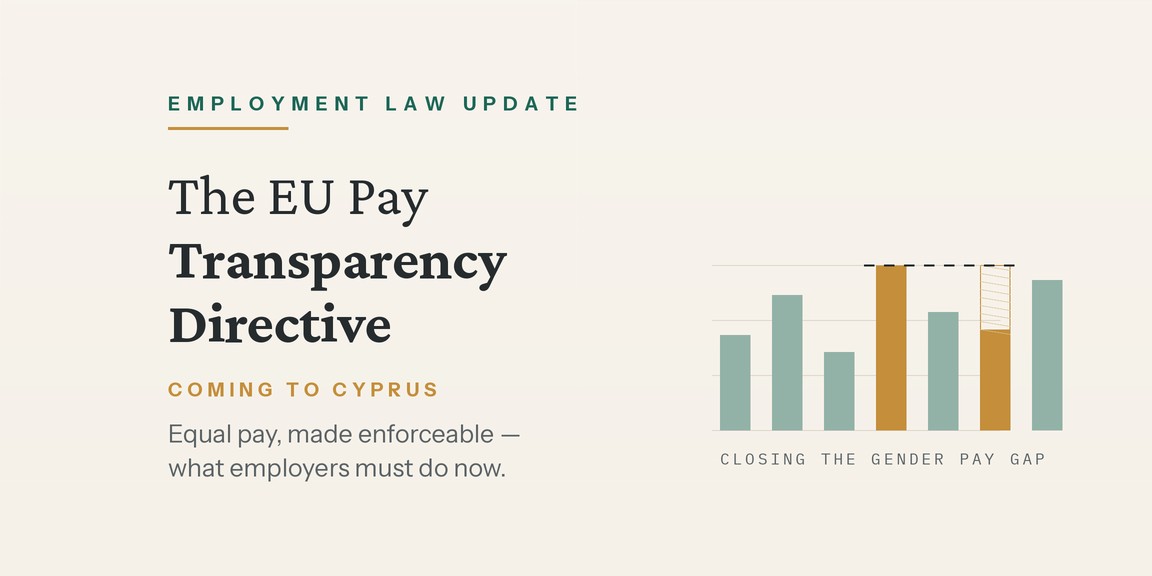
For more than two decades, the principle of equal pay for equal work has been part of Cyprus law. In practice, however, it has been difficult to enforce: pay has traditionally been treated as a private matter, individually negotiated and rarely disclosed, leaving employees with little way of knowing whether they were being paid fairly. The EU Pay Transparency Directive (Directive (EU) 2023/970) is designed to change that, shifting the equal pay principle from aspiration to obligation, and placing the burden squarely on employers to demonstrate that their pay practices are fair.
The Directive’s transposition deadline of 7 June 2026 has now passed, but Cyprus has not yet enacted its implementing legislation. A draft bill was first published for consultation in November 2025 and revised in January 2026, under the title “The Strengthening of the Implementation of the Principle of Equal Remuneration between Men and Women for Equal Work or Work of Equal Value, through Wage Transparency and Enforcement Mechanisms Law of 2026.” The bill remains within the legislative process and is expected to be adopted in due course. With the deadline already behind us, Cyprus employers should treat the new regime as imminent and begin preparing now, particularly because, in several respects, the draft goes further than the Directive’s minimum requirements.
This article outlines the key changes and the practical steps employers should take.
The Existing Cyprus Framework
Cyprus already prohibits pay discrimination on grounds of sex through the Equal Pay between Men and Women for the Same Work or for Work of Equal Value Law (Law 177(I)/2002) and the Equal Treatment of Men and Women in Employment and Vocational Training Law (Law 205(I)/2002). These laws establish the right but offer employees limited practical tools to identify or challenge unequal pay.
The new regime would build on this foundation and supply what is currently missing: transparency, hard reporting obligations, enforcement mechanisms, and a meaningful shift in the burden of proof. It is also designed to operate alongside existing structures – notably the Transparent and Predictable Terms of Employment Law of 2023 and the ERGANI system, Cyprus’s state-operated digital register of employment terms, which already collects salary and job data and is expected to provide the baseline for pay gap analysis.
What Changes for Employers
The following reflects the obligations set out in the published draft bill. The detail may be refined before the law is enacted, but the direction of travel is clear and employers can prepare on this basis.
Pay transparency before hiring
Employers will be required to provide candidates with information on the starting salary or its range, and any relevant collective agreement provisions, before the interview stage. Vacancy notices and job titles must be gender-neutral, and employers will be prohibited from asking candidates about their pay history. This brings transparency to the very point at which pay gaps are often created.
Transparency during employment
Pay levels and the criteria used to determine pay and pay progression must be objective, gender-neutral and easily accessible to employees. Workers will have the right to request information about their own pay level and about the average pay levels, broken down by sex, for categories of employees performing the same work or work of equal value. The draft contemplates a limited exemption from the pay-progression transparency requirement for smaller employers.
Gender pay gap reporting
Larger employers will be required to report on their gender pay gap on a recurring basis, with obligations phased in by headcount. Under the Directive’s framework, the first reports from the largest employers are due in 2027 (covering 2026 data), with smaller employers phased in over subsequent years. Where reporting reveals a gender pay gap above the threshold set by the Directive (5%) that cannot be objectively justified, the employer must conduct a joint pay assessment in cooperation with employee representatives and take corrective action.
A reversed burden of proof
Perhaps the most consequential change for litigation risk: where an employer has failed to meet its transparency or reporting obligations, the burden of proof shifts to the employer in equal pay disputes. In practice, this means that an employer who has not kept its pay architecture transparent and well-documented may have to prove the absence of discrimination, rather than the employee having to prove its presence.
Where Cyprus Goes Further
The Cyprus draft is among the more demanding implementations in the EU, exceeding the Directive’s baseline in several respects:
Explicit weighting of job evaluation criteria. Employers must not only assess work of equal value using objective, gender-neutral criteria (skill, effort, responsibility and working conditions), but also document how those criteria are weighted and, where employee representatives exist, agree those weightings jointly with them.
A broad definition of pay. The draft adopts a wide definition encompassing basic salary and any other benefits in cash or in kind, received directly or indirectly, including variable and additional elements provided by law, collective agreement or established practice. This breadth matters for both equal pay analysis and reporting.
A four-year retrospective look-back. Employees may, on request, obtain pay information looking back over a multi-year period, increasing the importance of well-maintained historical records.
ERGANI integration and meaningful sanctions. Implementation is anchored in the existing ERGANI registration system, and the draft contemplates significant enforcement, including financial penalties and, in certain cases, criminal sanctions for non-compliance.
The precise scope of these provisions may be refined as the bill completes its passage; the above reflects the position under the published draft.
What Cyprus Employers Should Do Now
Audit your pay data. Identify which roles constitute “equal work or work of equal value,” map employees to objective criteria, and run a pay gap analysis to understand your exposure before any reporting obligation crystallises. It is far better to discover and address an unjustified gap internally than to have it surface in a mandatory report.
Build a defensible pay architecture. Document objective, gender-neutral criteria for setting pay and progression, and be prepared to justify the weighting applied to each. Pay decisions that cannot be objectively explained are the principal source of risk under the new regime.
Review recruitment practices. Remove salary-history questions from application forms and interviews, ensure job adverts and titles are gender-neutral, and put in place a process for disclosing pay ranges to candidates.
Get your records and systems ready. Ensure ERGANI data is accurate and complete, and that your HR systems can respond to information requests, including the multi-year look-back, within the required timeframes.
Engage with employee representatives. Joint pay assessments and the agreement of job-evaluation weightings require constructive engagement with worker representatives. Early, well-managed dialogue will reduce both compliance and employee-relations risk.
How We Can Help
Our firm advises employers across Cyprus on equal pay and pay transparency compliance, job evaluation and pay structures, gender pay gap reporting, recruitment practices and the management of related disputes. We can help you assess your exposure, build a defensible pay framework and prepare for the new obligations before they are enforced. If you would like to discuss what the Pay Transparency Directive and its Cyprus implementing law mean for your organisation, we would be pleased to assist.
This article is provided for general information purposes only and does not constitute legal advice. It reflects the position as at the time of writing, including the status of draft legislation that remains subject to change; readers should seek specific advice on their circumstances.
Theodorou Law is a Cyprus law firm with Cyprus lawyers and other legal experts on legal matters involving Cyprus law, EU law and international law. The above should be used as a source of general information only. It is not intended to give a definitive statement of the law.
If you have a query or wish to receive further information, please contact us using [email protected]