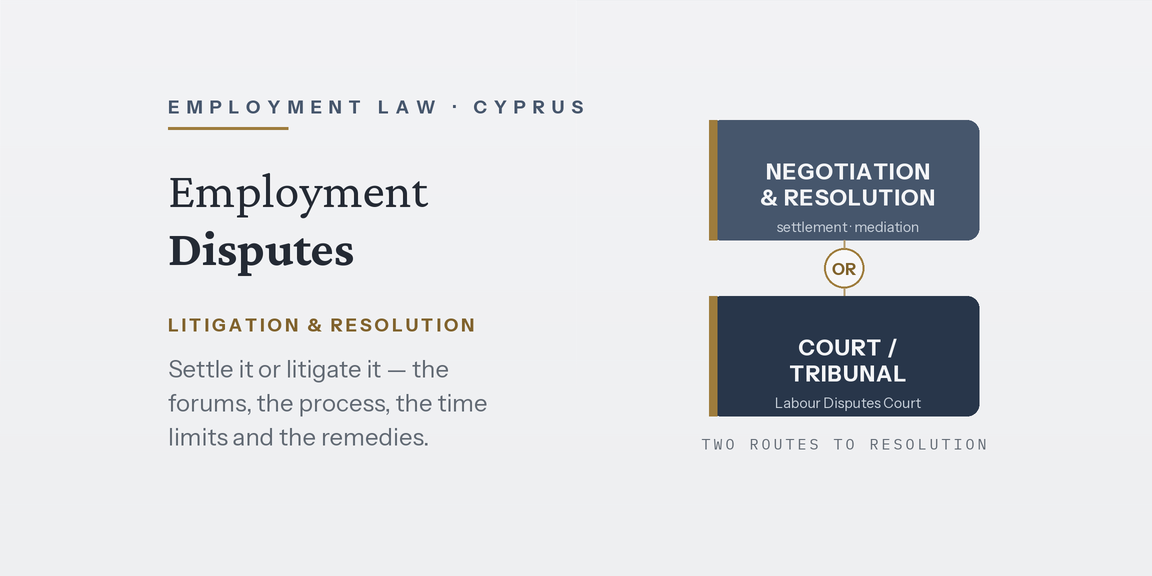
When an employment relationship breaks down, the dispute that follows can be resolved in several ways by negotiation or before a court. Knowing what what a court can order and how long you have to act is essential, whether you are an employer managing risk or an employee enforcing your rights. This guide explains how employment disputes are determined in Cyprus.
The Labour Disputes Court and the District Court
Most individual employment disputes in Cyprus are heard by the Labour Disputes Court (the Industrial Disputes Tribunal), a specialist court with exclusive jurisdiction over matters arising from the employment relationship, including unfair dismissal, redundancy, notice and payment in lieu, annual leave, maternity protection and equal treatment. It sits in Nicosia, Limassol, Larnaca and Paphos.
Its jurisdiction is not unlimited. The Labour Disputes Court can award compensation for unlawful dismissal up to a ceiling of two years’ wages; where a claim exceeds that ceiling, it falls to the District Court. The District Court also handles certain other employment claims, broadly, contractual claims and those arising in circumstances outside the tribunal’s remit. A key practical point is that pursuing a claim in one forum generally excludes the other, so the choice of forum must be made carefully at the outset.
The Labour Disputes Court is designed to be more accessible and less formal than ordinary civil litigation, while still following proper legal procedure. It is composed of a presiding judge sitting with two lay members, one drawn from the employers’ side and one from the employees’ side, on the recommendation of their respective organisations. The lay members bring practical workplace experience; their role is advisory, and the judge decides the case. Parties may be represented by a lawyer (and, in appropriate cases, by a trade-union officer).
The remedies available include compensation — assessed within the statutory range, no less than the redundancy payment the employee would have received and no more than two years’ wages — and, where a larger employer has dismissed unlawfully and in bad faith, reinstatement. The way compensation is calculated, and the grounds on which a dismissal is judged, are explained in our guides to termination and redundancy and to unfair and wrongful dismissal.
Time Limits
Employment claims are subject to strict limitation periods, and missing them can be fatal to an otherwise good claim:
- A claim before the Labour Disputes Court must generally be brought within 12 months of the date the dispute arose (for example, the date of dismissal).
- Where an employee’s redundancy claim has been rejected by the Redundancy Fund, a claim may be brought before the Labour Disputes Court within a shorter window running from the notice of rejection.
- Contractual claims before the District Court are subject to the longer general limitation period that applies to civil claims.
Because the periods differ by forum and claim, anyone considering, or facing, a claim should take advice promptly.
Appeals
Decisions of the Labour Disputes Court may be appealed, but generally only on points of law, the appeal court will not re-open the tribunal’s findings of fact. This makes the first-instance hearing, and the evidence put before it, decisive; it is not a rehearsal.
Resolving Disputes Without Litigation
Litigation is rarely the first or best option. A range of alternatives can resolve matters faster, more privately and at lower cost:
Negotiation and settlement. Many disputes are resolved by a negotiated settlement, often recorded in a settlement or separation agreement that brings finality for both sides. A well-drafted agreement is frequently the most efficient outcome of all.
Mediation. Independent mediation allows the parties to reach their own agreement with the help of a neutral third party. In the labour context, the Ministry of Labour and Social Insurance also provides conciliation and mediation services.
The Industrial Relations Code. For collective and trade-union disputes, the voluntary Industrial Relations Code sets out a staged process, direct negotiation, mediation through the Department of Labour Relations, and, where the parties agree, arbitration, aimed at resolving matters without industrial action or litigation.
Practical Guidance
For employers. The outcome of most disputes is shaped long before any hearing — by the reason for the decision and the process followed. Document decisions, follow fair procedures, and take advice early; a sound settlement is usually cheaper than a contested claim.
For employees. Act quickly, as the time limits are short and the choice of forum matters. Keep your contract, payslips and all correspondence, and obtain advice before accepting or rejecting any offer.
How We Can Help
Our employment law team advises both employers and employees at every stage of a dispute — assessing the merits, choosing the right forum, negotiating and drafting settlements, and conducting proceedings before the Labour Disputes Court and the District Court.
This article is provided for general information purposes only and does not constitute legal advice. It reflects the position as at the time of writing; readers should seek specific advice on their circumstances.
Theodorou Law is a Cyprus law firm with Cyprus lawyers and other legal experts on legal matters involving Cyprus law, EU law and international law. The above should be used as a source of general information only. It is not intended to give a definitive statement of the law.
For advice tailored to your circumstances, please contact us using [email protected] to arrange a consultation with our employment law team.