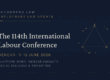
The 112th Session of the International Labour Conference (ILC), the annual gathering of the International Labour Organization, often described as the “world parliament of labour”, was held in Geneva from 3 to 14 June 2024, bringing together government, employer and worker delegates from the ILO’s 187 Member States, Cyprus among them. Convened in the year marking the 80th anniversary of the Declaration of Philadelphia, the session placed the often-overlooked care economy at the heart of its work and began the process of creating the first international standard on biological hazards at work.
As an ILO Member State, Cyprus is required to bring newly adopted instruments before the House of Representatives, and the discussions held in Geneva regularly foreshadow developments in domestic law and policy. Below, we summarise the key outcomes and what they signal for employers and employees in Cyprus.
Decent Work and the Care Economy
The centrepiece of the 112th Session was a general discussion on decent work and the care economy. The Conference recognised the central, yet frequently undervalued and underpaid, role of care work, both paid and unpaid, in sustaining economies and societies, and concluded that promoting decent work in the care sector is essential to achieving gender equality and social justice.
The relevance to Cyprus is direct. With an ageing population and significant reliance on domestic and care workers, including many migrant workers, the care economy is a substantial part of the Cyprus labour market. The Conference’s conclusions point towards continued policy attention on fair pay and conditions for care and domestic workers, investment in care services, and measures to help workers reconcile employment with caring responsibilities, themes that connect closely with the work-life balance and family-leave framework already developing in Cyprus and the EU. Employers in care-intensive sectors should anticipate growing scrutiny of pay, working time and conditions.
A First Step on Biological Hazards
The Conference also held the first of two standard-setting discussions on protection against biological hazards in the working environment. This opening discussion is the first stage of the ILO’s law-making process; a second and concluding discussion is expected at the 113th Session in 2025, with the adoption of a Convention and accompanying Recommendation anticipated.
If adopted, this would be the first dedicated international labour standard addressing the risks posed to workers by exposure to viruses, bacteria, fungi and other biological agents, risks underscored by recent global health experience and relevant well beyond healthcare, extending to agriculture, food processing, waste management, cleaning and emergency services. For Cyprus, the emerging instrument would complement the existing occupational safety and health framework, built on the Safety and Health at Work legislation and subsidiary regulations on exposure to biological agents derived from EU law. Employers should treat this as an early signal to keep biological risk assessment firmly within their general duty to provide a safe working environment.
Fundamental Principles and Rights at Work
The Conference held its recurrent discussion on fundamental principles and rights at work, the core labour rights that all ILO Member States are committed to respect, including freedom of association and collective bargaining, the elimination of forced and child labour, the elimination of discrimination, and, since 2022, a safe and healthy working environment. The recurrent discussion reviews how these principles are being given effect worldwide and guides the ILO’s future support to member states. For Cyprus, which has ratified the fundamental Conventions, it reaffirms the standards against which national law and practice continue to be measured.
Other Business: Modernising the Rulebook
In a more technical but significant exercise, the Conference moved to abrogate several outdated international labour Conventions, part of the ILO’s ongoing effort to keep the body of international labour law current and fit for the modern world of work. The session also elected the members of the ILO Governing Body for the 2024 – 27 term of office.
Why This Matters for Cyprus
The 112th Session points clearly to the direction of international labour policy: a sharper focus on the care economy and gender equality, and the imminent arrival of a global standard on biological hazards in the workplace. For Cyprus employers, the practical takeaways are to keep occupational safety and health policies — including biological risk assessment — under active review; to anticipate increasing attention to pay and conditions in care and domestic work; and to keep wider employment practices aligned as international standards continue to feed into Cyprus and EU law.
How We Can Help
Our employment law team advises employers and employees across Cyprus on occupational safety and health, the engagement of care and domestic workers, equal treatment and wider regulatory compliance, and follows developments in Nicosia, Brussels and Geneva closely. If you would like to understand how the outcomes of the 112th International Labour Conference may affect your organisation, we would be pleased to assist.
This article is provided for general information purposes only and does not constitute legal advice. It reflects the position as at the time of writing; readers should seek specific advice on their circumstances.
Theodorou Law is a Cyprus law firm with Cyprus lawyers and other legal experts on legal matters involving Cyprus law, EU law and international law. The above should be used as a source of general information only. It is not intended to give a definitive statement of the law.
If you have a query or wish to receive further information, please contact us using [email protected]