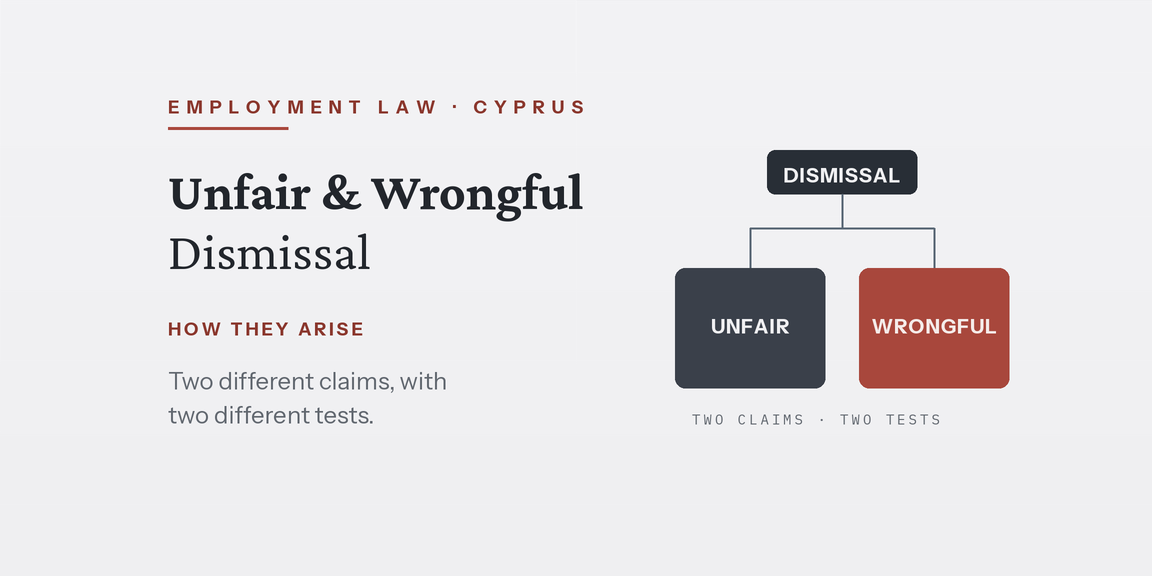
“Unfair dismissal” and “wrongful dismissal” are often used interchangeably, but in Cyprus they are distinct claims with different requirements, forums and remedies. Understanding the difference matters: an employee may have one claim, both, or neither, and the value of each is calculated in a different way. This guide explains both, and how they fit together. For the notice periods and redundancy entitlements that sit alongside them, see our guide to termination of employment and redundancy.
Unfair Dismissal – the Statutory Claim
Unfair dismissal is a statutory protection under the Termination of Employment Law of 1967 (Law 24/1967). An employee with at least 26 weeks of continuous service who is dismissed without a lawful reason may bring a claim before the Labour Disputes Court, generally within 12 months of the termination.
The law recognises only certain grounds for dismissal — broadly, the employee’s conduct or unsatisfactory performance, redundancy, force majeure, the expiry of a genuine fixed-term contract, and reaching pensionable age. If the employer cannot show that the dismissal rested on a lawful ground and was carried out fairly, it is likely to be unfair. Some dismissals are treated as automatically unfair — notably those connected with trade-union membership or activity, or with an employee asserting their rights.
What it is worth. Compensation is assessed by the Court and, by statute, is no less than the redundancy payment the employee would have received and no more than two years’ wages, taking into account factors such as earnings, length of service, age and loss of career prospects. Where a larger employer dismisses unlawfully and in bad faith, the Court also has power, on the employee’s application, to order reinstatement. A key point for employers: once the employee shows they were dismissed, the burden is on the employer to justify it.
Wrongful Dismissal – the Contractual Claim
Wrongful dismissal is different. It is not about whether the dismissal was fair, but about whether it was carried out in breach of the contract, most commonly, dismissal without the notice (or payment in lieu) the employee was entitled to, or termination of a fixed-term contract before its expiry without justification.
Two features distinguish it from unfair dismissal. First, there is no minimum length of service, the right depends on the contract, not on a qualifying period. Second, the measure of damages is different: it is essentially the value of what the employee would have received had proper notice been given (the pay and benefits over the notice period), rather than the statutory unfair-dismissal compensation. An employee dismissed summarily for serious misconduct that genuinely justifies it will not succeed in a wrongful-dismissal claim, because the contract permits dismissal without notice in such cases.
Constructive Dismissal
An employee is not always dismissed in express terms. Where an employer commits a serious breach of the employment contract — for example, a unilateral and fundamental change to pay or duties — and the employee resigns in response, the law may treat this as a constructive dismissal, opening the door to an unfair-dismissal claim as though the employer had dismissed the employee. These cases are fact-sensitive and the employee’s response must be prompt.
How the Claims Fit Together
The same dismissal can give rise to both claims, or to only one. An employee with long service dismissed without notice and without a fair reason may have both an unfair-dismissal claim (statutory compensation) and a wrongful-dismissal claim (notice pay). A senior employee with only a few months’ service dismissed without notice may have no unfair-dismissal claim (not enough service) but a good wrongful-dismissal claim (breach of the notice term). Identifying which claims arise — and quantifying each — is central to advising on any dismissal.
Practical Guidance
For employees. Act quickly: the unfair-dismissal time limit is strict, and prompt advice preserves your options. Keep your contract, payslips and any correspondence about the dismissal.
For employers. Most claims are won or lost on the reason for dismissal and the process followed. Identify a lawful ground, document it, give proper notice or pay in lieu, and allow the employee a genuine opportunity to respond where conduct or performance is in issue. Taking advice before acting is far cheaper than defending a claim or paying up to two years’ wages in compensation.
How We Can Help
We advice both employees and employers on dismissals, assessing the strength of a claim or defence, quantifying exposure, negotiating settlements, and conducting proceedings before the Labour Disputes Court.
This article is provided for general information purposes only and does not constitute legal advice. It reflects the position as at the time of writing; readers should seek specific advice on their circumstances.
Theodorou Law is a Cyprus law firm with Cyprus lawyers and other legal experts on legal matters involving Cyprus law, EU law and international law. The above should be used as a source of general information only. It is not intended to give a definitive statement of the law.
For advice tailored to your circumstances, please contact us using [email protected] to arrange a consultation with our employment law team.