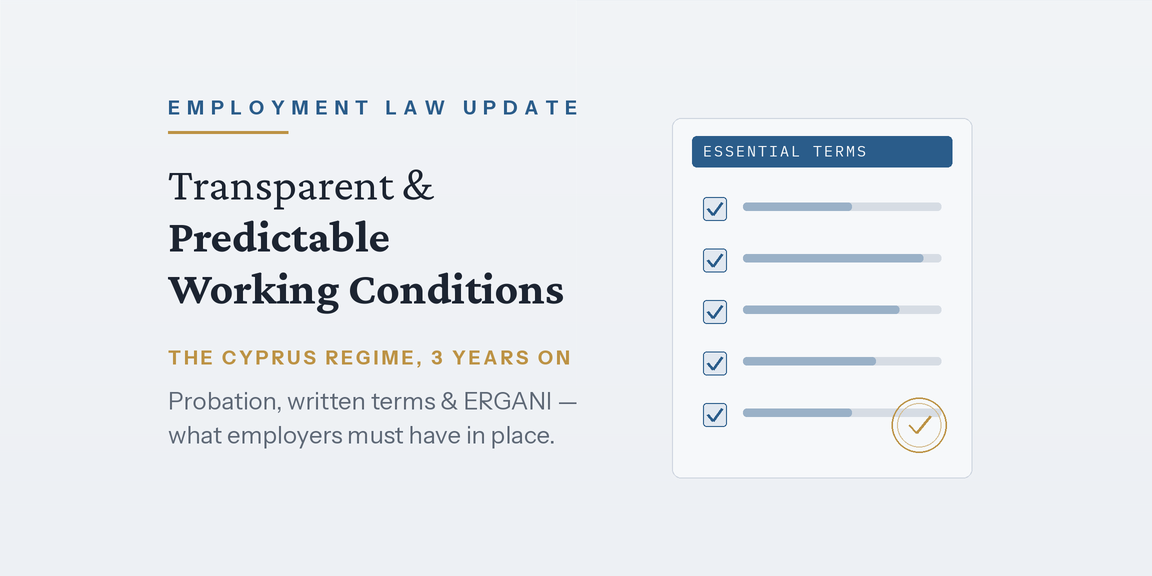
Since Directive (EU) 2019/1152 on transparent and predictable working conditions was transposed into Cyprus law by the Transparent and Predictable Working Conditions Law of 2023 (Law 25(I)/2023), the framework governing how employers inform and engage their staff has been transformed. We reported on the Directive when it was adopted at EU level, on its implementation in Cyprus in April 2023 and on the mandatory ERGANI registration obligation that followed.
Three years on, the obligations are well established — but they are also increasingly enforced, and the data employers were required to submit to the State now sits at the centre of a wider transparency agenda. This update consolidates the position as it stands in 2026 and sets out what every Cyprus employer should now have in place.
A Quick Recap: What the Law Changed
The Law replaced the earlier information regime (the Notification of Terms of Employment Law of 2000, Law 100(I)/2000) and expanded, in both scope and detail, what employers must tell their employees. It also introduced a series of substantive new rights. The key changes, which we covered in detail at the time, were:
A six-month cap on probation. Probationary periods can no longer exceed six months, a decisive break from the previous position, under which probation could run up to 104 weeks by written agreement. For fixed-term contracts, the probationary period must be proportionate to the expected duration of the contract and the nature of the work.
Parallel employment. Employers cannot, as a rule, prevent an employee from taking work with another employer outside their schedule, or subject them to adverse treatment for doing so. Restrictions are permitted only on objective grounds such as health and safety, business confidentiality, the integrity of the public service, or the avoidance of conflicts of interest.
Controls on on-demand (“zero-hour”) work. Casual, on-demand arrangements are permitted only within defined limits, designed to prevent the abuse of unpredictable work.
The right to request more secure employment. An employee with at least six months’ service may request a form of employment with more predictable and secure conditions and is entitled to a reasoned written reply.
Mandatory training at the employer’s cost. Where training is required by law or collective agreement for the employee to do the job, it must be provided free of charge, count as working time and, where possible, take place during working hours.
Breach of the Law exposes an employer, on conviction, to a fine. Beyond the financial penalty, however, the greater exposure now lies in the evidential and reputational consequences of poor documentation.
The Development That Changed Day-to-Day Compliance: ERGANI
The most consequential practical step came not with the Law itself but with what followed. As we reported in January 2025, amendments to the Law published in the Official Gazette on 15 November 2024, together with Decree Κ.Δ.Π. 455/2024 of 20 December 2024, introduced an obligation on every employer to register the essential terms of employment of all employees in the State’s ERGANI information system, within a window that ran from 2 January to 28 February 2025.
The terms that must be registered are extensive, covering the employer and employee details, place of work, job title and specialisation, commencement date (and end date for fixed-term contracts), the details of any indirect employer for agency arrangements, the terms and duration of any probationary period, annual leave, remuneration and pay frequency, normal working hours, whether those hours are unpredictable, and any additional benefits such as allowances or cost-of-living adjustments.
ERGANI is designed to hold real-time data on the terms of employment across the labour market. Its significance for employers is twofold. First, the essential terms of employment are now visible to the State, not merely agreed privately. Second, and increasingly relevant in 2026, that dataset is the natural foundation for the next wave of transparency obligations, including gender pay gap analysis under the forthcoming pay transparency regime, which we examine in our update on the EU Pay Transparency Directive. Employers who treat ERGANI as a one-off 2025 exercise rather than a living record are exposed on both fronts.
What This Means for Employers in 2026
The transition period is over. What were, in 2023, “new” obligations are now simply the baseline against which employers are judged — and the existence of a centralised ERGANI record makes shortcomings easier to identify. In practice, the position in 2026 is that compliance is assumed, and gaps stand out.
What Cyprus Employers Should Check Now
Contracts and written statements. Confirm that every employee has received the full set of information the Law requires, within the prescribed timeframes (core information before commencement or within seven days; the remainder within one month). Contracts and templates that predate April 2023 are very likely incomplete.
Probation clauses. Ensure no contract provides for probation exceeding six months outside the limited exceptions, and that fixed-term probation periods are proportionate. Align recruitment and performance management with the shorter window, bearing in mind its interaction with the Termination of Employment Law.
ERGANI records. Treat ERGANI as the authoritative, living record of each employee’s terms. Verify that the initial registration was completed, and ensure new hires and any changes to terms are entered accurately and promptly, not left until a deadline forces the issue.
Requests and flexible arrangements. Maintain a clear process for responding, in writing and with reasons, to requests for more predictable employment, and for handling parallel-employment and unpredictable-schedule questions consistently.
Manager awareness. Most compliance risk arises at hiring, probation and scheduling — decisions taken by line managers. Ensure they understand the limits the Law imposes.
How We Can Help
Our firm advises employers across Cyprus on contracts and written statements of employment, probationary periods, ERGANI registration and compliance, and the rights introduced by the Transparent and Predictable Working Conditions Law. We can audit your existing documentation and ERGANI records, identify gaps, and bring your practices into line before they are tested, whether by an employee, a regulator, or the broader transparency obligations now taking shape. If you would like to discuss your position, we would be pleased to assist.
This article is provided for general information purposes only and does not constitute legal advice. It reflects the position as at the time of writing; readers should seek specific advice on their circumstances.
Theodorou Law is a Cyprus law firm with Cyprus lawyers and other legal experts on legal matters involving Cyprus law, EU law and international law. The above should be used as a source of general information only. It is not intended to give a definitive statement of the law.
If you have a query or wish to receive further information, please contact us using [email protected]