A landmark first standard on biological hazards, and the first step towards regulating platform work
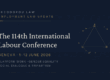
The 113th Session of the International Labour Conference (ILC) , the annual gathering often described as the “world parliament of labour”, was held in Geneva from 2 to 13 June 2025, bringing together government, employer and worker delegates from the International Labour Organization’s 187 Member States, Cyprus among them. This year’s session produced one genuinely historic outcome and set in motion another reform that will shape employment law across Europe in the years ahead.
For Cyprus employers and employees, the decisions taken in Geneva matter: as an ILO Member State, Cyprus is required to bring newly adopted instruments before the House of Representatives, and the standards agreed at the Conference frequently foreshadow changes to domestic law. Below, we summarise the key outcomes.
Protection Against Biological Hazards
The headline outcome of the 113th Session was the adoption of the first-ever international labour standard on the protection of workers against biological hazards in the working environment — a new Convention, accompanied by a Recommendation. Until now, no dedicated international instrument addressed the risks posed to workers by exposure to viruses, bacteria, fungi and other biological agents, despite the lessons of recent global health emergencies.
The new instrument requires States and employers to identify, assess and manage biological risks in the workplace, and to put in place preventive and protective measures. Its relevance extends well beyond healthcare and laboratories to sectors such as agriculture, food processing, waste management, cleaning and emergency services.
For Cyprus, the instrument complements the existing occupational safety and health framework, built on the Safety and Health at Work legislation and the subsidiary regulations governing exposure to biological agents derived from EU law. Should Cyprus move to ratify, employers can expect a renewed focus on biological risk assessment as part of their general duty to ensure a safe working environment.
The First Step Towards Regulating Platform Work
The Conference also held its first discussion on decent work in the platform economy, the ride-hailing, delivery, care and freelance digital work coordinated through apps and online platforms. This first discussion is the opening stage of the ILO’s standard-setting process, with a second and concluding discussion expected at the 114th Session in 2026, where a Convention and Recommendation are anticipated.
The central questions under debate ,how platform workers should be classified, the transparency and oversight of the algorithms that allocate work and determine pay, and access to social protection and collective rights, are precisely those now being addressed at EU level through the Platform Work Directive. Cyprus businesses that engage workers through digital platforms should treat this as an early signal of the direction of travel and begin reviewing their engagement models now.
From the Informal to the Formal Economy
A further agenda item addressed innovative approaches to promoting transitions from the informal to the formal economy. While this general discussion does not by itself create binding obligations, its conclusions guide the ILO’s future work and inform national policy on undeclared work, social-security coverage and fair competition — all matters of continuing relevance to the Cyprus labour market.
Supervision, Child Labour and Social Justice
As in every session, the Committee on the Application of Standards examined how Member States are giving effect to the Conventions they have ratified, the supervisory machinery that gives international labour standards real force in domestic legal systems. The Conference also marked the World Day Against Child Labour on 12 June, with a call for stronger labour inspection and investment in education, and advanced discussions on social justice and the ILO’s contribution to the Second World Summit for Social Development.
Why This Matters for Cyprus
Cyprus has a consistent record of engagement with ILO standards, having ratified the great majority of the fundamental Conventions, most recently ILO Convention No. 190 on violence and harassment in the world of work, which we reported on. The outcomes of the 113th Session point clearly to the next areas of focus: occupational safety and health in the face of biological risks, and the regulation of platform and digital work.
Prudent employers should: review their occupational safety and health policies to ensure biological risks are properly assessed and managed; monitor developments on platform work at both ILO and EU level if they engage app-based or contractor labour; and keep their wider employment practices under review as international standards continue to feed into Cyprus law.
How We Can Help
Our firm advises employers and employees across Cyprus on occupational safety and health, workforce classification, collective labour relations and regulatory compliance, and monitors developments in Nicosia, Brussels and Geneva closely. If you would like to understand how the outcomes of the 113th International Labour Conference may affect your organisation, we would be pleased to assist.
This article is provided for general information purposes only and does not constitute legal advice. It reflects the position as at the time of writing; readers should seek specific advice on their circumstances.
If you have a query or wish to receive further information, please contact us using [email protected]